
If you have ever purchased car insurance, health insurance, homeowners insurance, or life insurance, you have probably come across the word premium.
But what is an insurance premium, and why do different people pay different amounts for similar types of coverage?
An insurance premium is the money a policyholder pays to an insurance company for insurance coverage. Depending on the policy, the premium may be paid monthly, quarterly, annually, or according to another payment schedule. The exact price depends on the type of insurance, the amount of coverage, the insurer’s assessment of risk, and other factors that vary by insurance product and location. The National Association of Insurance Commissioners (NAIC) defines a premium as money charged for insurance coverage that reflects the expected cost of losses.
Understanding your insurance premium is important because the premium is only one part of the total cost of an insurance policy.
A policy can have a low premium but a high deductible or lower coverage limits. Another policy may cost more upfront but provide different coverage or lower out-of-pocket costs when a covered event occurs.
In this guide, we will explain what an insurance premium is, how insurance premiums work, what can affect the price, the difference between a premium and a deductible, and what to consider when comparing insurance policies.
What Is an Insurance Premium?
An insurance premium is the amount you pay an insurance company to maintain your insurance coverage.
Think of it as the price of the insurance protection provided by your policy.
For example, suppose your auto insurance premium is $150 per month. If that amount remains unchanged for a full year, you would pay $1,800 in premiums over the year.
The premium does not mean the insurance company will pay every expense you have. Instead, it pays for the coverage described in your policy.
Your policy may include coverage limits, deductibles, exclusions, conditions, and other requirements.
The premium is therefore best understood as the cost of having the insurance protection in place, rather than a payment that guarantees every possible loss will be covered.
For homeowners and renters policies, the NAIC describes the premium as the cost for the policy term, generally after applicable discounts have been applied.
How Do Insurance Premiums Work?
Insurance companies collect premiums from many policyholders.
The insurer then uses the money it collects, along with other financial resources, to operate the business and pay covered claims and other expenses.
The basic idea behind insurance is risk sharing.
Not every policyholder will experience a covered loss during the policy period. Some people may make no claims at all, while others may experience losses that result in significant claim payments.
Insurance companies use underwriting and pricing methods to estimate the risks associated with providing coverage.
The premium charged to an individual policyholder is influenced by factors associated with the expected likelihood and cost of claims, along with other expenses and considerations relevant to the insurance product and applicable regulations.
This is why two people can sometimes receive different insurance premiums even when they are purchasing similar types of coverage.
How Is an Insurance Premium Calculated?
There is no single formula that applies to every type of insurance.
Different insurance products use different rating factors.
In general, insurers evaluate information that helps them estimate the potential cost and likelihood of claims.
For example, auto insurers may consider factors such as driving history, location, vehicle type, annual mileage, claims history, selected coverage, and deductible. The NAIC notes that rating factors can vary by state and insurance company.
Homeowners insurance can involve different factors, including location, claims history, the cost to rebuild the home and replace covered contents, the home’s characteristics, coverage limits, and deductible.
The important point is that insurance premiums are risk-based, but the exact factors used depend on the type of insurance and the rules that apply where you live.
What Factors Affect Insurance Premiums?
Several factors can influence the cost of an insurance policy.
Type of Insurance
The type of coverage you purchase is one of the most obvious factors.
Auto insurance, health insurance, homeowners insurance, renters insurance, life insurance, and disability insurance all protect against different risks.
Because the potential losses are different, the way premiums are calculated also differs.
Amount of Coverage
Generally, choosing more coverage or higher limits can affect the premium.
For example, a policy with higher liability limits may cost more than one with lower limits, although the relationship varies by insurance product and insurer.
When comparing policies, it is important to compare similar coverage levels rather than simply choosing the lowest quoted price.
Deductible
Your deductible can also affect your premium.
A deductible is the amount you may be responsible for paying toward a covered loss before the insurer pays according to the policy.
In many types of insurance, choosing a higher deductible can reduce the premium because you are agreeing to take on more of the initial cost if a covered loss occurs.
The NAIC notes this relationship for homeowners insurance and advises consumers to make sure they can afford the higher out-of-pocket amount before increasing a deductible.
Location
Where you live can influence insurance pricing.
For example, auto insurance pricing can vary by location because insurers may face different levels of claims, traffic, theft, weather-related risks, or other factors in different areas.
Home insurance can also be affected by location and exposure to particular risks.
Location is therefore an important part of the pricing process for many insurance products.
Claims History
Your previous claims history can affect premiums for certain types of insurance.
An insurer may consider past claims when assessing the likelihood or potential cost of future claims.
However, the exact impact varies by insurance type, insurer, and applicable state rules.
Personal Risk Factors
Insurance companies may consider personal characteristics or risk-related information when permitted by applicable laws.
For auto insurance, examples can include driving history, vehicle use, annual mileage, and vehicle type.
For homeowners insurance, factors can include property characteristics and claims history.
The specific factors used vary, so it is important not to assume that the pricing formula for one type of insurance applies to another.
What Is the Difference Between a Premium and a Deductible?
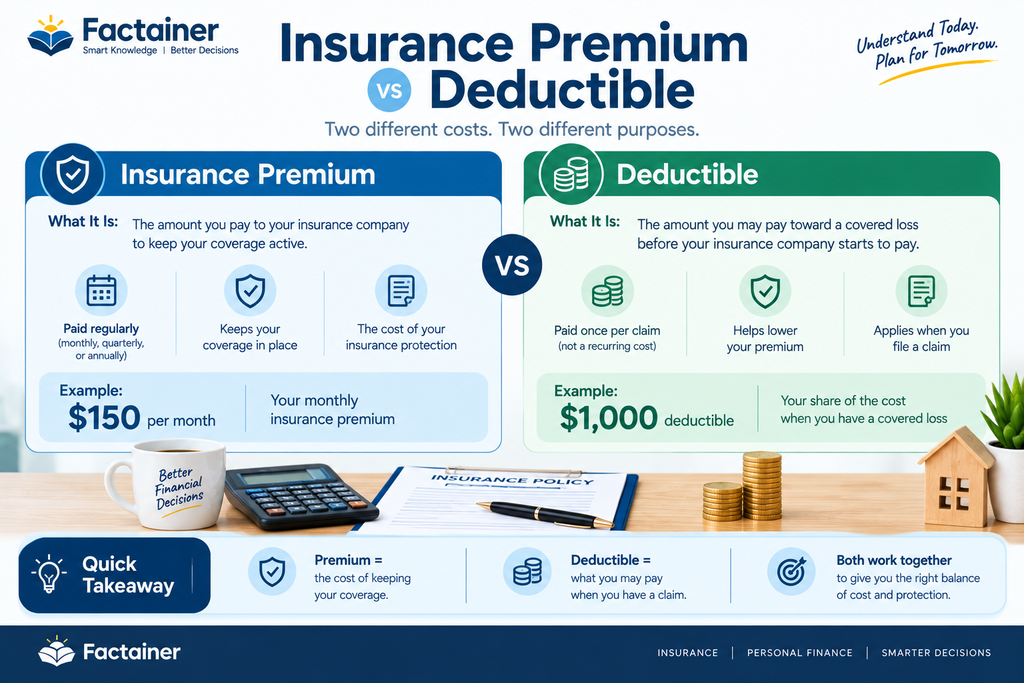
A premium and a deductible are two completely different parts of an insurance policy.
Insurance Premium
The premium is what you pay to maintain your insurance coverage.
For example:
$150 per month = your insurance premium
Insurance Deductible
The deductible is an amount you may have to pay toward a covered loss before the insurer pays its share under the policy.
For example:
$1,000 deductible = the amount you may pay first on a covered loss
Consider a simple example.
Suppose you have a policy with:
- $150 monthly premium
- $1,000 deductible
- $50,000 coverage limit
You pay the $150 premium to maintain the policy.
If you later have a covered loss, the $1,000 deductible may apply before the insurer pays the eligible remaining amount, subject to the policy’s terms and limits.
The premium and deductible therefore serve different purposes.
The premium is the cost of maintaining the insurance.
The deductible is part of what you may pay when you experience a covered loss.
Why Do Some Policies Have Higher Premiums?
A policy can have a higher premium for many reasons.
It may provide higher coverage limits, broader protection, a lower deductible, or other benefits.
It may also be priced higher because the insurer estimates that the underlying risk has a greater expected cost.
For example, auto insurance premiums can be affected by the vehicle being insured, the driver’s history, location, selected coverage, and other rating factors.
With homeowners insurance, the cost to rebuild the property and the risks associated with its location can also influence pricing.
This is why it is not useful to ask whether a premium is simply “high” or “low” without considering what the policy provides.
Monthly vs Annual Insurance Premiums
Insurance premiums can often be presented as monthly or annual amounts.
For example, an insurer might quote:
$120 per month
or
$1,440 per year
If the monthly amount remains unchanged for 12 months, the two amounts are equivalent.
However, payment schedules can differ by insurer and policy.
Some policies may offer different payment arrangements, and fees or discounts may affect the final amount.
When comparing payment options, look at the total cost over the policy period rather than focusing only on the monthly figure.
What Is an Annual Insurance Premium?
An annual insurance premium is the amount charged for insurance coverage over a one-year policy period when the policy is structured on an annual basis.
For example, if your annual auto insurance premium is $1,800, that is the total premium for the policy period before considering any changes, refunds, adjustments, or other applicable charges.
Annual premiums can make it easier to compare the total cost of insurance.
However, your policy documents should always be used to confirm the actual premium and payment schedule.
What Is a Monthly Insurance Premium?
A monthly insurance premium is the amount you pay each month for insurance coverage when the policy uses monthly payments.
For example, a health insurance plan may require a monthly premium.
Health insurance can also include other costs such as deductibles, copayments, coinsurance, and out-of-pocket maximums. The NAIC notes that paying a health insurance premium does not mean all healthcare costs are automatically covered.
This is an important distinction.
The premium gives you access to the coverage described by the policy, but you may still have other costs when you use the insurance.
Does a Higher Premium Mean Better Insurance?
Not necessarily.
A higher premium does not automatically mean that an insurance policy is better for your situation.
A more expensive policy may offer higher limits, broader coverage, a lower deductible, or additional benefits.
But those features may or may not be important for your specific needs.
Instead of asking only:
“Which insurance policy is cheapest?”
or
“Which policy has the highest premium?”
compare:
- Coverage
- Coverage limits
- Deductibles
- Exclusions
- Benefits
- Out-of-pocket costs
- Policy conditions
- Premium
- Claims process
Comparing the entire policy gives you a more useful picture of what you are actually purchasing.
Can You Lower Your Insurance Premium?
In some situations, there may be ways to reduce an insurance premium.
The options depend heavily on the type of insurance and your circumstances.
Compare Quotes
Getting quotes from multiple insurers can help you compare pricing for similar coverage.
Make sure the policies being compared have similar limits, deductibles, and benefits.
Otherwise, the cheapest quote may simply be offering less protection.
Ask About Discounts
Some insurers offer discounts based on qualifying factors.
For example, discounts may be available for certain safety features, multiple policies, claims-free histories, or other qualifying circumstances.
The available discounts vary by insurer and location.
Consider Your Deductible
A higher deductible can sometimes reduce the premium.
However, you should only consider this if you could comfortably afford the deductible after a covered loss.
The NAIC specifically recommends making sure you have enough money available to pay a higher deductible before increasing it.
Review Your Coverage
Your insurance needs can change.
If your circumstances change, reviewing your coverage can help you determine whether the policy still fits your needs.
For example, your vehicle may become older, your household may change, or you may purchase a different home.
Do not reduce important coverage simply to save money without understanding the financial risk you would be accepting.
Insurance Premium vs Total Cost of Insurance
One of the most common mistakes people make is treating the premium as the entire cost of insurance.
It is not always the complete picture.
Depending on the policy, you may also have:
- Deductibles
- Copayments
- Coinsurance
- Fees
- Out-of-pocket expenses
- Coverage gaps
- Costs for excluded services or losses
For health insurance, for example, the NAIC explains that consumers may have premiums as well as deductibles, copayments, coinsurance, and other out-of-pocket expenses.
For property insurance, your deductible can significantly affect how much you pay after a covered loss.
This is why you should consider both the cost of the policy and the financial protection it provides.
How Insurance Premiums Can Change
Your insurance premium may not always remain the same.
Premiums can change when your policy renews or when relevant circumstances change, depending on the insurance product and applicable rules.
For example, an auto premium may be affected by changes in driving history, claims, vehicle information, location, coverage, or other rating factors.
Home insurance premiums can also change based on factors such as property characteristics, claims history, location, rebuilding costs, and other risk considerations.
Broader changes in claim costs and insurance risk can also affect premiums.
The NAIC reported in 2024 that rising home and auto insurance premiums were associated with factors including expected claim costs and risk factors, while emphasizing that pricing factors vary by state.
If your premium changes, review your renewal documents and compare the new price with the coverage you are receiving.
How to Read the Premium on Your Insurance Policy
When reviewing your insurance documents, look for the section that shows your premium.
Depending on the policy, you may see information such as:
- Policy period
- Total premium
- Payment schedule
- Discounts
- Coverage limits
- Deductibles
- Additional coverage
- Taxes or fees
For homeowners and renters insurance, the declarations page commonly lists the premium along with other important policy information.
If something on the policy does not make sense, contact your insurance company or a qualified insurance professional for clarification.
Do not assume that two similar-looking policies have identical coverage.
Common Mistakes to Avoid When Comparing Premiums
Comparing only the monthly price
A $100 policy is not necessarily a better deal than a $130 policy.
The $130 policy could have higher limits, broader coverage, or a lower deductible.
Ignoring the deductible
A low premium with a very high deductible may not fit your financial situation.
Comparing different coverage levels
Always compare policies on a similar basis.
Forgetting exclusions
A policy may have important exclusions that affect the protection it provides.
Assuming premiums stay the same forever
Insurance prices can change over time.
Review your policy and renewal documents rather than assuming your previous premium will continue indefinitely.
Insurance Premiums and Personal Finance
Your insurance premium should be considered as part of your overall personal finance plan.
Insurance is designed to help manage financial risk, while budgeting and saving help you manage your everyday finances and build financial reserves.
For example, you might include insurance premiums in your monthly budget alongside:
- Housing
- Utilities
- Food
- Transportation
- Debt payments
- Emergency savings
- Retirement contributions
- Investing
The goal is not simply to find the cheapest insurance premium.
The goal is to balance the cost of insurance with the amount of financial protection you need.
A policy that is inexpensive but leaves you exposed to a potentially devastating loss may not be appropriate.
At the same time, paying for coverage you do not need can unnecessarily increase your expenses.
Understanding your risks can help you make more informed decisions.
Frequently Asked Questions About Insurance Premiums
What is an insurance premium in simple terms?
An insurance premium is the amount you pay an insurance company for insurance coverage. It may be paid monthly, annually, or according to another schedule.
Is an insurance premium the same as a deductible?
No. A premium is the cost of maintaining your insurance coverage. A deductible is an amount you may have to pay toward a covered loss before the insurer pays according to the policy.
Why are insurance premiums different for different people?
Insurance premiums can differ because insurers evaluate different risk factors, coverage choices, locations, claims histories, and other information depending on the type of insurance and applicable rules.
Can I lower my insurance premium?
Sometimes. Options may include comparing quotes, asking about available discounts, reviewing coverage, or choosing a different deductible when appropriate. Any change should be considered alongside the protection you may give up.
Does a higher insurance premium mean better coverage?
Not necessarily. A higher premium may reflect higher limits, broader coverage, a lower deductible, or other features, but price alone does not determine whether a policy is appropriate.
What is a monthly insurance premium?
A monthly insurance premium is the amount you pay each month to maintain insurance coverage under a monthly payment arrangement.
What is an annual insurance premium?
An annual insurance premium is the premium charged for a one-year policy period when the policy is structured on an annual basis.
Why did my insurance premium increase?
Premiums can change for many reasons, including changes in risk, claims costs, personal or property factors, coverage, location, and other rating considerations. The reasons vary by insurance type and location.
Final Thoughts
So, what is an insurance premium?
An insurance premium is the amount you pay an insurance company for the coverage provided by your policy.
It is one of the most important numbers to understand when comparing insurance, but it should not be the only number you consider.
Look at the premium together with the deductible, coverage limits, exclusions, benefits, and potential out-of-pocket costs.
A lower premium may reduce your regular expenses, but it can sometimes come with a higher deductible or less protection. A higher premium may provide additional coverage or lower certain out-of-pocket costs, but that does not automatically make it the right choice.
The best approach is to understand what you are paying for and how the policy fits into your broader financial plan.
When you understand how insurance premiums work, you can compare policies more effectively and make decisions based on both cost and protection.
For a broader introduction to insurance, start with our complete beginner’s guide to how insurance works.
1 thought on “What Is an Insurance Premium? How It Works and What You Pay”