
Insurance can be confusing when you first start looking at policies. There are different companies, coverage limits, deductibles, premiums, exclusions, policy terms, and dozens of insurance products designed for different risks.
The good news is that you do not necessarily need every type of insurance available. The goal is to understand which types of insurance protect the things that matter most to you, how each policy generally works, and where coverage gaps could create a major financial problem.
Insurance is essentially a financial protection tool. Instead of paying the entire cost of certain unexpected losses yourself, you pay an insurance company a premium in exchange for coverage under the terms of a policy.
The major types of insurance in the United States include health insurance, auto insurance, homeowners insurance, renters insurance, life insurance, disability insurance, long-term care insurance, umbrella insurance, flood insurance, travel insurance, pet insurance, and business insurance.
This guide explains these insurance types in simple language so you can understand what they cover, who may need them, and how they fit into an overall personal finance plan.
Quick answer: The most common types of personal insurance include health, auto, homeowners, renters, life, disability, and umbrella insurance. Other specialized policies, such as flood, travel, pet, and long-term care insurance, can help protect against specific risks.
What Are the Different Types of Insurance?
Different types of insurance exist because people face different financial risks.
For example:
- A driver faces the risk of a car accident.
- A homeowner faces risks involving property damage, theft, liability, and certain natural disasters.
- A renter may need protection for personal belongings and liability even though they do not own the building.
- A family may depend on one person’s income and therefore consider life or disability insurance.
- A traveler may want protection against certain trip-related losses.
- A pet owner may want help managing eligible veterinary expenses.
Insurance policies are designed around specific risks and types of financial losses.
The National Association of Insurance Commissioners (NAIC) groups consumer insurance resources into areas such as homeowners, life and annuities, auto, health, flood, military, small business, and long-term care insurance.
Understanding the difference between these categories is the first step toward building an insurance plan that fits your financial situation.
1. Health Insurance
Health insurance helps pay for eligible medical expenses.
Depending on the plan, health insurance may help cover expenses such as:
- Doctor visits
- Hospital services
- Prescription drugs
- Preventive care
- Laboratory services
- Emergency care
- Certain specialist services
- Other covered medical services
In the United States, people may obtain health insurance through an employer, the individual Marketplace, government programs, or other sources.
Health insurance is different from many other insurance products because the cost structure can include several components.
How Health Insurance Costs Work
A health insurance plan may include:
- Premium: The amount you pay for coverage, often monthly.
- Deductible: The amount you may have to pay for certain covered services before the plan begins paying according to its terms.
- Copayment: A fixed amount you pay for a covered service.
- Coinsurance: A percentage of the allowed cost that you pay after meeting applicable deductible requirements.
- Out-of-pocket maximum: A limit on what you pay for covered services during a plan year, subject to the plan’s rules.
HealthCare.gov explains that when comparing Marketplace plans, consumers should consider total yearly costs rather than looking only at the monthly premium. Total costs can include premiums, deductibles, copayments, coinsurance, and the out-of-pocket maximum.
Example of Health Insurance
Imagine a health plan has:
- $300 monthly premium
- $2,000 deductible
- 20% coinsurance
- $7,000 out-of-pocket maximum
The $300 premium is paid to maintain coverage whether or not you use medical services.
If you receive covered medical care, the deductible and other cost-sharing rules may determine how much you pay.
This is why a plan with the lowest premium is not automatically the plan with the lowest total potential cost.
Who May Need Health Insurance?
Health insurance can be important for anyone who could face significant medical expenses.
A serious illness, accident, hospitalization, or ongoing treatment can create substantial financial costs. Health insurance is designed to reduce the amount of covered medical expenses that an individual must pay directly.
2. Auto Insurance
Auto insurance protects against certain financial losses involving vehicles.
Auto insurance can include different types of coverage, depending on the policy and applicable state requirements.
Common coverage categories include:
- Liability coverage
- Collision coverage
- Comprehensive coverage
- Uninsured motorist coverage
- Underinsured motorist coverage
- Medical payments coverage
- Personal injury protection in applicable states
- Rental reimbursement or similar optional coverage
Auto insurance requirements vary by state. The NAIC notes that most states require drivers to carry at least some basic level of auto insurance, although the exact requirements differ.
Liability Insurance
Liability coverage generally helps protect you when you are legally responsible for injuries to other people or damage to their property, subject to policy terms and limits.
For example, if you cause an accident and another driver suffers covered damages, your liability coverage may respond up to the policy limits.
Collision Coverage
Collision coverage generally helps pay for damage to your insured vehicle resulting from a covered collision.
For example, if your vehicle hits another vehicle or object, collision coverage may help with repairs after the applicable deductible.
Comprehensive Coverage
Comprehensive coverage generally protects against certain non-collision losses, depending on the policy.
Examples can include:
- Theft
- Certain weather-related damage
- Falling objects
- Vandalism
- Animal-related damage
Why Auto Insurance Matters
A vehicle accident can create two major financial problems:
- Damage to your own vehicle.
- Liability for damage or injuries involving other people.
The right combination of coverage and limits depends on factors such as your vehicle, financial situation, state requirements, and risk tolerance.
3. Homeowners Insurance
Homeowners insurance is designed for people who own a home.
A typical homeowners policy can provide several forms of protection, including coverage for the dwelling, personal property, liability, and additional living expenses, depending on the policy.
The NAIC explains that homeowners policies generally cover the home’s structure and commonly provide coverage for personal property and personal liability for covered accidents.
What Does Homeowners Insurance Cover?
Common coverage categories include:
Dwelling Coverage
This generally covers the physical structure of the home against covered causes of loss.
It can include parts such as:
- Walls
- Roof
- Floors
- Attached structures
- Built-in appliances
Other Structures
This can apply to structures on the property that are not attached to the main house, such as certain:
- Garages
- Sheds
- Fences
- Other structures
Coverage depends on the policy.
Personal Property
Personal property coverage can protect eligible belongings such as:
- Furniture
- Clothing
- Electronics
- Appliances
- Other possessions
High-value items such as jewelry, collectibles, or specialized equipment may have special limits or require additional coverage.
Liability Coverage
Homeowners liability coverage can help protect you against certain claims involving bodily injury or property damage for which you are legally responsible.
Additional Living Expenses
If a covered loss makes the home temporarily unlivable, a policy may provide additional living expense coverage subject to its terms and limits.
Important: Homeowners Insurance Does Not Cover Everything
One of the biggest mistakes homeowners make is assuming that every type of property damage is automatically covered.
Certain risks may require separate coverage or an endorsement.
Flood insurance is a major example. Standard homeowners insurance generally does not cover flood damage, and flood insurance is available through separate policies, including coverage associated with the National Flood Insurance Program and private insurers.
Earthquake coverage may also require a separate policy or endorsement depending on the situation.
4. Renters Insurance
Renters insurance is designed for people who rent a home, apartment, or other residential property.
A renter usually does not need to insure the building itself because that responsibility generally belongs to the property owner.
Instead, renters insurance can focus on:
- Personal belongings
- Personal liability
- Certain additional living expenses
- Other coverage specified in the policy
The NAIC explains that renters insurance differs from homeowners insurance because the renter generally insures their contents and personal liability rather than the building structure.
Example
Imagine you rent an apartment and own:
- $3,000 of electronics
- $5,000 of furniture
- $2,000 of clothing
- $1,500 of other personal items
A covered event could potentially damage many of those belongings.
Without renters insurance, you may have to absorb the loss yourself.
Renters Insurance and Liability
Renters insurance can also provide liability protection for certain covered incidents.
For example, if a guest is injured in your rented home and you are legally responsible, liability coverage may potentially respond according to your policy.
5. Life Insurance
Life insurance is designed to provide a financial benefit to designated beneficiaries after the insured person’s death, subject to the policy’s terms.
Life insurance can be especially relevant when other people depend on your income.
Possible beneficiaries may include:
- Spouse
- Children
- Parents
- Other family members
- Business partners
- Organizations
The two broad categories most consumers encounter are term life insurance and cash-value life insurance.
The NAIC explains that life insurance products generally fall into these two broad classes.
Term Life Insurance
Term life insurance provides coverage for a specified period.
Examples include:
- 10-year term
- 20-year term
- 30-year term
If the insured person dies during the covered term, the policy may pay the death benefit to the named beneficiaries according to the policy.
Term life insurance is often used when someone wants financial protection during a specific period.
For example, a parent may want coverage while children are young and a mortgage is outstanding.
Permanent or Cash-Value Life Insurance
Permanent life insurance can provide coverage that is designed to remain in force for a longer period, subject to policy requirements.
Some permanent policies can also build cash value.
Examples include:
- Whole life insurance
- Universal life insurance
- Variable life insurance
These products can be more complex than term life insurance because they may involve cash value, fees, investment-related features, interest assumptions, or other policy mechanics.
How Much Life Insurance Do You Need?
There is no universal number that works for everyone.
Consider:
- Household income
- Number of dependents
- Mortgage balance
- Other debts
- Education goals
- Existing savings
- Employer-provided coverage
- Funeral and final expenses
- Future financial obligations
The goal is to estimate the financial gap your family could face if your income disappeared.
6. Disability Insurance
Disability insurance protects against a different risk from life insurance.
Life insurance primarily addresses the financial impact of death.
Disability insurance addresses the potential loss of income when an illness or injury prevents someone from working according to the policy’s definition of disability.
For many working adults, income is one of their most valuable financial assets.
Consider a person earning $70,000 per year.
If that person cannot work for an extended period because of a qualifying disability, the financial impact could be significant.
Disability insurance may provide income replacement benefits according to the policy.
Short-Term Disability Insurance
Short-term disability coverage generally provides benefits for a limited period after a qualifying disability.
Long-Term Disability Insurance
Long-term disability insurance can provide benefits for a substantially longer period, depending on the policy.
Important policy features can include:
- Benefit amount
- Waiting period
- Benefit period
- Definition of disability
- Exclusions
- Benefit adjustments
- Return-to-work provisions
Why Disability Insurance Matters
People often insure their homes and cars while overlooking their ability to earn income.
For someone who relies heavily on employment income, protecting that income can be an important part of financial planning.
7. Umbrella Insurance
Umbrella insurance provides an additional layer of liability protection above certain underlying policies.
It is generally designed to supplement coverage such as:
- Auto insurance
- Homeowners insurance
- Renters insurance
The NAIC describes personal umbrella insurance as coverage that can provide protection for liability and defense costs beyond what primary policies cover, subject to the umbrella policy’s terms.
Example
Suppose you have an auto liability policy with a particular liability limit.
You are involved in a serious accident and are found legally responsible for damages that exceed that limit.
An umbrella policy may provide additional liability protection if the loss qualifies under the umbrella policy and its underlying coverage requirements have been satisfied.
What Umbrella Insurance Does Not Usually Do
Umbrella insurance is primarily about liability protection.
It is not a replacement for homeowners or auto insurance.
For example, an umbrella policy generally does not function as a substitute for physical damage coverage on your vehicle or your home.
8. Flood Insurance
Flood insurance protects against certain flood-related losses that are generally not covered by standard homeowners insurance.
This is an important distinction.
Many homeowners assume that because they have homeowners insurance, their home is protected from every type of water-related damage.
That is not necessarily true.
The NAIC states that flood damage is generally not covered under a standard homeowners policy and that flood insurance is a separate form of coverage available to homeowners, renters, and businesses.
Who Should Consider Flood Insurance?
Flood insurance may be worth considering if:
- Your property is in a flood-prone area.
- Your community has experienced flooding.
- Your home is near a river, lake, coastline, or drainage area.
- Your property could be affected by heavy rainfall.
- Your mortgage or lender requirements make coverage relevant.
- You want protection against a risk excluded from your standard policy.
Flood risk is not limited to one geographic region.
A property does not necessarily have to be directly beside a body of water to experience flooding.
Flood Insurance vs Homeowners Insurance
Think of them as two different layers:
Homeowners insurance: protects against covered risks specified in the homeowners policy.
Flood insurance: specifically addresses covered flood losses under its own policy.
Always read the actual policy because coverage, exclusions, limits, and definitions matter.
9. Long-Term Care Insurance
Long-term care insurance is designed to help pay for certain long-term care services.
These services can include care provided:
- At home
- In assisted living
- In nursing facilities
- Through certain community-based services
Long-term care can become a significant financial concern as people age.
The NAIC notes that long-term care insurance can cover various forms of ongoing care, including home health care, personal care, assisted living, adult day care, respite care, and hospice care, depending on the policy.
Why Long-Term Care Is Different
Health insurance and long-term care insurance do not serve exactly the same purpose.
Health insurance is primarily designed around medical care.
Long-term care insurance addresses qualifying ongoing care needs.
What to Consider
If evaluating long-term care insurance, look at:
- Daily benefit
- Benefit period
- Elimination period
- Inflation protection
- Covered services
- Eligibility requirements
- Premiums
- Exclusions
- Nonforfeiture provisions
Long-term care policies can be complicated, so consumers should carefully review the policy and understand how benefits are triggered.
10. Travel Insurance
Travel insurance is designed to address certain risks associated with travel.
Depending on the policy, coverage can include certain losses related to:
- Trip cancellation
- Trip interruption
- Travel delays
- Lost baggage
- Emergency medical expenses
- Other travel-related events
The NAIC describes travel insurance as coverage for risks associated with traveling, including losses involving luggage, cancellations, and delays.
When Might Travel Insurance Make Sense?
Travel insurance can become more relevant when:
- The trip is expensive.
- Deposits are nonrefundable.
- You are traveling internationally.
- Medical expenses abroad could be significant.
- You are taking a long or complicated trip.
- You have several prepaid reservations.
Read the Fine Print
Travel insurance policies can have exclusions and eligibility conditions.
Do not assume every cancellation reason is covered.
Always check:
- Covered reasons
- Exclusions
- Medical coverage
- Pre-existing condition provisions
- Cancellation rules
- Baggage limits
- Documentation requirements
11. Pet Insurance
Pet insurance is designed to help manage certain eligible veterinary expenses.
It can include different coverage structures.
The NAIC identifies three broad categories commonly offered by pet insurers:
- Accident-only
- Accident and illness
- Wellness coverage
Coverage, exclusions, deductibles, waiting periods, and limits can vary significantly between policies.
Accident-Only Pet Insurance
This type of policy generally focuses on eligible injuries resulting from accidents.
Accident and Illness Insurance
This can provide broader coverage for eligible accidents and illnesses.
Wellness Coverage
Wellness coverage may focus on routine care, depending on the plan.
Important Pet Insurance Terms
Pay attention to:
- Deductible
- Reimbursement percentage
- Annual limits
- Lifetime limits
- Waiting periods
- Exclusions
- Pre-existing conditions
- Covered treatments
Pet insurance can be especially relevant because veterinary care can sometimes become expensive unexpectedly.
12. Business Insurance
Business insurance is designed to protect businesses against different operational and financial risks.
The exact coverage needed depends heavily on the type of business.
Common business insurance categories can include:
- General liability insurance
- Commercial property insurance
- Business interruption coverage
- Commercial auto insurance
- Professional liability insurance
- Workers’ compensation insurance
- Cyber insurance
- Product liability coverage
- Employment-related liability coverage
General Liability Insurance
General liability insurance can protect a business against certain claims involving:
- Bodily injury
- Property damage
- Certain personal or advertising injuries
Professional Liability Insurance
Professional liability insurance is particularly relevant for businesses that provide professional services or advice.
Depending on the profession, it may be known by names such as:
- Errors and omissions insurance
- Malpractice insurance
Commercial Property Insurance
This can help protect eligible business property against covered losses.
A business might need coverage for:
- Building
- Equipment
- Inventory
- Furniture
- Computers
- Other business property
Business Insurance Is Not One Policy
One of the most important lessons for business owners is that there is no single insurance policy that automatically covers every business risk.
A restaurant, software company, contractor, doctor, online store, and consulting business can have very different insurance needs.
Personal Insurance vs Specialized Insurance
A useful way to organize the major insurance types is to separate them into two groups.
Personal Insurance
Personal insurance generally protects individuals and households.
Examples include:
- Health insurance
- Auto insurance
- Homeowners insurance
- Renters insurance
- Life insurance
- Disability insurance
- Umbrella insurance
- Long-term care insurance
- Pet insurance
Specialized Insurance
Specialized insurance addresses more specific situations.
Examples include:
- Flood insurance
- Travel insurance
- Business insurance
- Commercial auto insurance
- Professional liability insurance
- Specialty property coverage
The right policy depends on the risk you are trying to protect against.
How Do You Know Which Types of Insurance
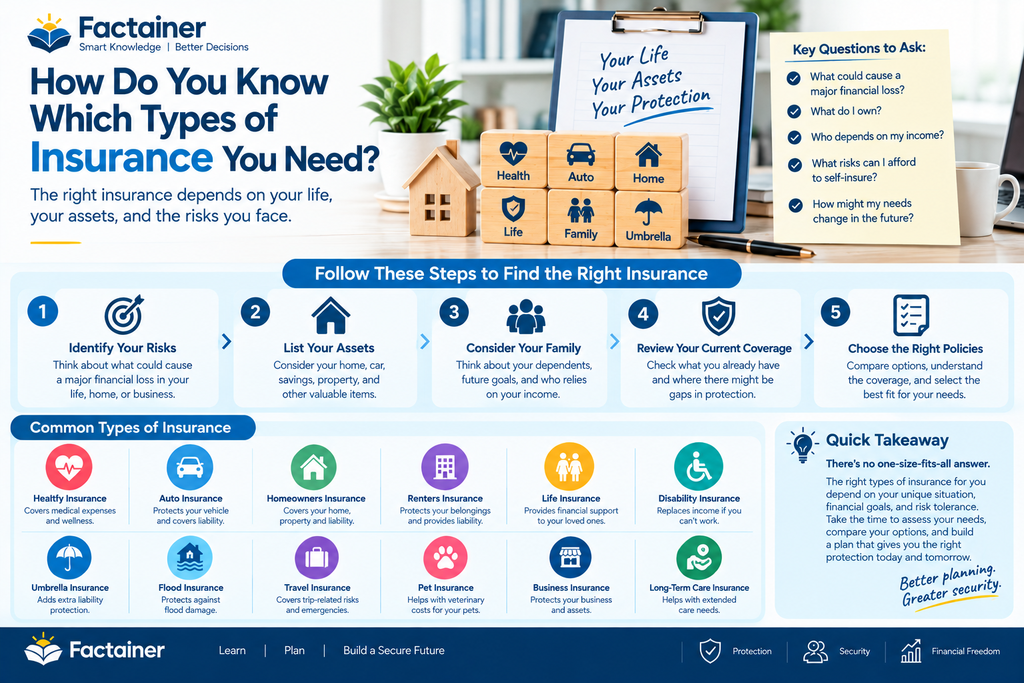
You do not necessarily need every type of insurance.
You Need?
Instead, start by identifying your largest financial risks.
Ask yourself:
1. What Could Cause a Major Financial Loss?
Think about:
- Medical expenses
- Vehicle accidents
- Property damage
- Lawsuits
- Loss of income
- Death of an income provider
- Flooding
- Long-term care
- Business interruption
2. What Assets Do You Own?
Your insurance needs can change as your financial situation changes.
For example:
- Buying a home may create a need for homeowners insurance.
- Buying a car creates auto insurance considerations.
- Starting a business can create business insurance needs.
- Having children can change life insurance needs.
- Building wealth can make liability protection more important.
3. Who Depends on Your Income?
If your spouse, children, or other family members rely heavily on your income, life and disability insurance may become more important considerations.
4. What Risks Can You Afford to Self-Insure?
Not every small risk requires insurance.
If you could easily pay for a small loss from savings, you may decide to handle that risk yourself.
But a potentially catastrophic loss can be much harder to absorb.
For example, replacing a $500 appliance is very different from rebuilding a home after a major covered loss.
How Much Insurance Coverage Do You Need?
The amount of coverage you need depends on your circumstances.
There is no universal insurance amount that works for everyone.
Consider these factors:
Income
Your income determines how much financial support your household may lose if you cannot work or die.
Assets
The more assets you have, the more important it may become to evaluate liability protection and appropriate coverage limits.
Debts
Mortgages, auto loans, personal loans, and other debts can affect the amount of life insurance or other financial protection your household may need.
Dependents
Children and other dependents can increase your need for financial protection.
Lifestyle
Your vehicle, home, travel habits, business activities, and hobbies can all affect your risk profile.
Location
Insurance risks vary significantly by location.
For example, flood, hurricane, wildfire, tornado, earthquake, and other risks can vary from one region to another.
Insurance Premium vs Deductible
Two of the most important insurance terms are premium and deductible.
A premium is the amount you pay for insurance coverage.
A deductible is the amount you may have to pay toward a covered loss before the insurer pays according to the policy.
Simple Example
Suppose your auto insurance has:
- $150 monthly premium
- $1,000 deductible
You pay the $150 premium to maintain your coverage.
If you later have a covered claim with a $5,000 covered loss and the $1,000 deductible applies, you may pay the first $1,000 and the insurer may pay the remaining covered amount, subject to policy terms and limits.
The two costs serve different purposes.
Premium = cost to maintain coverage
Deductible = your share of certain covered losses before insurance responds
This distinction is important when comparing insurance policies.
Does a Lower Premium Always Mean a Better Policy?
No.
A low premium can be attractive, but price is only one part of an insurance decision.
A policy with a lower premium may have:
- Higher deductible
- Lower coverage limits
- More exclusions
- Less optional coverage
- Different claim terms
A policy with a higher premium may provide different coverage or lower cost-sharing in certain situations.
For health insurance specifically, HealthCare.gov recommends comparing estimated total yearly costs rather than looking only at monthly premiums.
The same general principle is useful when evaluating other insurance: compare coverage, limits, deductibles, exclusions, and total potential cost, not simply the monthly price.
Common Insurance Mistakes to Avoid
Mistake 1: Buying Only the Cheapest Policy
Price should not be the only factor.
A cheap policy may not provide enough protection for your actual needs.
Mistake 2: Not Reading Exclusions
Every insurance policy has limitations.
Understand what is not covered.
Mistake 3: Choosing Very Low Coverage Limits
Low limits can reduce premiums but may leave you financially exposed if a large claim exceeds those limits.
Mistake 4: Ignoring Deductibles
A policy may look affordable until you realize that you would struggle to pay the deductible after a claim.
Mistake 5: Assuming Everything Is Covered
Flood damage is a classic example.
Standard homeowners policies generally do not cover flood damage, so separate flood coverage may be necessary.
Mistake 6: Forgetting to Update Policies
Life changes.
You may:
- Get married
- Have children
- Buy a house
- Move
- Buy a new vehicle
- Start a business
- Increase your income
- Acquire valuable property
Your insurance should be reviewed as your circumstances change.
Mistake 7: Not Comparing Total Costs
A low premium can hide higher deductibles or cost-sharing.
Always look at the entire financial picture.
How Insurance Fits Into Personal Finance
Insurance is not separate from personal finance.
It is one part of a broader financial plan.
Think of personal finance as having several layers:
Income → Emergency Savings → Insurance → Debt Management → Investing → Retirement Planning
Insurance can protect the progress you are making in other areas.
Imagine someone has built $100,000 in savings.
A major uninsured event could potentially eliminate a large portion of those savings.
Appropriate insurance can transfer certain risks to an insurer in exchange for premiums.
This does not mean you should insure every possible event.
Instead, insurance is most valuable when the potential financial loss is large enough to threaten your financial stability.
Insurance and Emergency Funds
Insurance and emergency savings work together.
An emergency fund can help you pay for unexpected expenses that insurance does not cover.
Insurance can help protect against larger covered losses.
For example:
Emergency fund: $10,000
Auto insurance: protects against certain vehicle-related risks
Health insurance: helps manage covered medical costs
Renters insurance: protects eligible personal property and liability
These tools have different jobs.
A strong financial plan often uses both savings and insurance rather than relying entirely on one.
How Often Should You Review Your Insurance?
A practical approach is to review your insurance at least periodically and whenever a major life event occurs.
Review your policies after:
- Marriage
- Divorce
- Birth or adoption of a child
- Buying a home
- Selling a home
- Buying a vehicle
- Starting a business
- Major home renovations
- Significant income changes
- Major changes in assets
- Moving to another state
Check:
- Coverage limits
- Deductibles
- Beneficiaries
- Premiums
- Exclusions
- Discounts
- New risks
- Policy endorsements
Your insurance needs should evolve as your financial life changes.
A Simple Insurance Checklist
Use this checklist to evaluate your current situation.
Health
- Do I have health coverage?
- Do I understand my deductible?
- Do I know my out-of-pocket maximum?
- Have I compared total potential annual costs?
Auto
- Do I meet my state’s required coverage?
- Are my liability limits appropriate for my situation?
- Do I have collision coverage if I need it?
- Do I understand my deductible?
Home
- Is my dwelling coverage appropriate?
- Is my personal property adequately covered?
- Do I have enough liability coverage?
- Do I need flood or earthquake coverage?
Renters
- Have I estimated the value of my belongings?
- Do I have renters liability coverage?
- Do I understand my deductible?
Life
- Does anyone depend on my income?
- Would my family have enough money if I died?
- Do I need term life insurance?
- Should I review my beneficiaries?
Disability
- What would happen if I could not work?
- Do I have employer disability coverage?
- Would my savings last long enough?
- Should I consider individual disability insurance?
Liability
- Could a major lawsuit threaten my assets?
- Would umbrella insurance be appropriate?
Specialized Risks
- Do I live in a flood-prone area?
- Do I travel frequently?
- Do I own pets?
- Do I operate a business?
- Could long-term care become a major financial concern?
Frequently Asked Questions About Types of Insurance
What are the main types of insurance?
The main types of personal insurance include health, auto, homeowners, renters, life, disability, and umbrella insurance. Specialized products include flood, travel, pet, long-term care, and business insurance.
What are the 4 most common types of insurance?
There is no universal official list of exactly four, but health, auto, homeowners or renters, and life insurance are among the major insurance categories many U.S. consumers encounter.
The right combination depends on your circumstances.
What type of insurance is required by law?
Requirements depend on the type of insurance and your location.
For example, auto insurance requirements vary by state. Many states require drivers to maintain certain minimum auto liability coverage.
Other insurance, such as homeowners insurance, may not be universally required by state law, although a mortgage lender may require coverage as a condition of the loan.
Is renters insurance required?
Renters insurance requirements can depend on the lease and local circumstances. A landlord may require tenants to carry renters insurance even though the tenant does not own the building.
Even when not required, renters insurance can help protect personal belongings and provide liability coverage according to the policy.
Is flood insurance included in homeowners insurance?
Generally, standard homeowners insurance does not cover flood damage.
Flood insurance is generally purchased separately.
What is the difference between life insurance and health insurance?
Life insurance is designed to provide a death benefit to named beneficiaries after the insured person’s death, subject to policy terms.
Health insurance helps pay for covered healthcare expenses while the insured person is alive and receiving eligible medical services.
What is the difference between premium and deductible?
A premium is what you pay for insurance coverage.
A deductible is an amount you may have to pay toward a covered loss before the insurer pays according to the policy.
Do I need umbrella insurance?
Umbrella insurance is generally intended to provide additional liability protection above certain underlying insurance policies.
Whether it makes sense depends on your assets, income, activities, existing liability limits, and risk exposure.
The NAIC notes that umbrella policies can provide additional liability and defense-cost protection beyond primary policies, subject to their terms.
Is pet insurance worth considering?
Pet insurance can help manage eligible veterinary expenses, but coverage varies widely.
Compare premiums, deductibles, reimbursement percentages, exclusions, waiting periods, and annual or lifetime limits before purchasing.
What is the most important insurance to have?
There is no single type of insurance that is equally important for everyone.
A homeowner may prioritize homeowners and liability coverage.
A renter may prioritize renters insurance.
A parent who supports a family may have significant life and disability insurance needs.
A driver needs to consider auto coverage.
Someone living in a flood-prone area may need flood insurance.
The right insurance plan depends on the financial risks that could cause the greatest damage to your household.
Final Thoughts: Understanding the Types of Insurance
Insurance can seem complicated because there are so many products and policy options.
But the basic idea is straightforward:
Identify your financial risks, determine which risks could seriously damage your finances, and use appropriate insurance to help protect against covered losses.
The major types of insurance include:
- Health insurance
- Auto insurance
- Homeowners insurance
- Renters insurance
- Life insurance
- Disability insurance
- Umbrella insurance
- Flood insurance
- Long-term care insurance
- Travel insurance
- Pet insurance
- Business insurance
You do not necessarily need every type of insurance.
Instead, focus on your actual financial situation.
Think about your income, assets, debts, family responsibilities, property, health coverage, location, and potential liabilities.
Then review your policies periodically as your life changes.
The best insurance strategy is not necessarily the one with the lowest premium. It is the one that provides appropriate protection for the risks that could otherwise create a serious financial problem.
Understanding insurance is therefore an important part of understanding personal finance.
Insurance protects the financial foundation. Saving builds the foundation. Investing helps grow it.