
If you have ever looked at an insurance policy and wondered what all the numbers and terms actually mean, you are not alone. Premiums, deductibles, coverage limits, exclusions, claims, and policy terms can make insurance seem much more complicated than it really is.
So, how does insurance work?
At its simplest, insurance is a way to manage financial risk. You pay an insurance company a certain amount of money, called a premium, and in return, the insurer agrees to provide financial protection against specific risks covered by your policy.
If a covered event happens, you can usually file a claim. The insurance company then reviews the claim and, if it is covered under the policy, pays the eligible amount according to the policy terms.
Understanding this basic process can make it easier to compare policies and decide what type of insurance may fit your financial situation.
In this guide, we will explain how insurance works, what premiums and deductibles mean, how claims work, and the most common types of insurance.
What Is Insurance?
Insurance is a financial protection arrangement between you and an insurance company.
You agree to pay a premium for coverage, while the insurer agrees to provide certain financial benefits if a covered event occurs.
For example, imagine that you own a car. An accident could result in thousands of dollars in repair costs or liability expenses. Instead of taking on all of that financial risk yourself, you can purchase auto insurance that provides certain types of protection.
The same basic concept applies to other forms of insurance.
Health insurance can help with covered healthcare expenses. Homeowners insurance can provide protection against certain property losses. Life insurance can provide a benefit to designated beneficiaries after the insured person’s death.
However, insurance does not automatically cover everything that can go wrong.
Your policy determines what is covered, what is excluded, how much the insurer may pay, and what costs you may have to pay yourself.
How Does Insurance Work?
The easiest way to understand how insurance works is to look at the process from beginning to end.
1. You identify a financial risk
Insurance starts with risk.
You may face financial risks related to your health, home, vehicle, income, family, or other parts of your life.
Some risks are relatively small and may be easy to handle with savings. Others could create a financial loss that would be difficult to manage on your own.
Insurance can help transfer some of that financial risk to an insurance company.
2. You choose an insurance policy
Once you identify a risk, you can look for an insurance policy designed to provide protection against specific losses.
An insurance policy is essentially a contract between you and the insurer.
The policy explains important details such as:
- What is covered
- What is excluded
- How much coverage you have
- Your premium
- Your deductible
- Coverage limits
- Policy conditions
- How claims are handled
This is why reading the policy matters. Two insurance policies may appear similar but provide different levels of protection.
3. You pay an insurance premium
The money you pay for insurance coverage is called a premium.
Depending on the type of insurance and the policy, premiums may be paid monthly, quarterly, annually, or according to another payment schedule.
Your premium can depend on several factors.
For example, insurers may consider information related to the type of coverage, amount of coverage, risk factors, location, claims history, and other factors relevant to the specific insurance product.
A lower premium does not necessarily mean a better policy.
A policy with a lower premium may have a higher deductible, lower coverage limits, or fewer benefits.
4. A covered event happens
At some point, you may experience an event that results in a financial loss.
The next question is whether the event is covered by your insurance policy.
This distinction is important.
For example, an insurance policy may cover certain types of property damage while excluding other causes of damage.
The policy may also have conditions that must be met before a claim is paid.
5. You file an insurance claim
If the event is potentially covered, you can file an insurance claim.
A claim is a request for the insurance company to provide benefits under the terms of your policy.
The insurer reviews the information associated with the claim and determines whether the loss is covered and what amount may be payable.
If the claim qualifies for coverage, the insurer pays the eligible amount according to the policy.
What Is an Insurance Premium?
An insurance premium is the amount you pay to maintain insurance coverage.
For example, suppose an auto insurance policy costs $150 per month.
If the premium stays the same throughout the year, your annual premium would be $1,800.
However, the premium is not necessarily the only cost you may face.
Depending on the type of insurance, you may also have a deductible, copayment, coinsurance, or other out-of-pocket expenses.
The National Association of Insurance Commissioners describes a premium as money charged for insurance coverage, reflecting the insurer’s expectation of loss.
This is why comparing insurance based only on the monthly premium can sometimes be misleading.
It is also important to understand what protection you receive for that price.
What Is an Insurance Deductible?
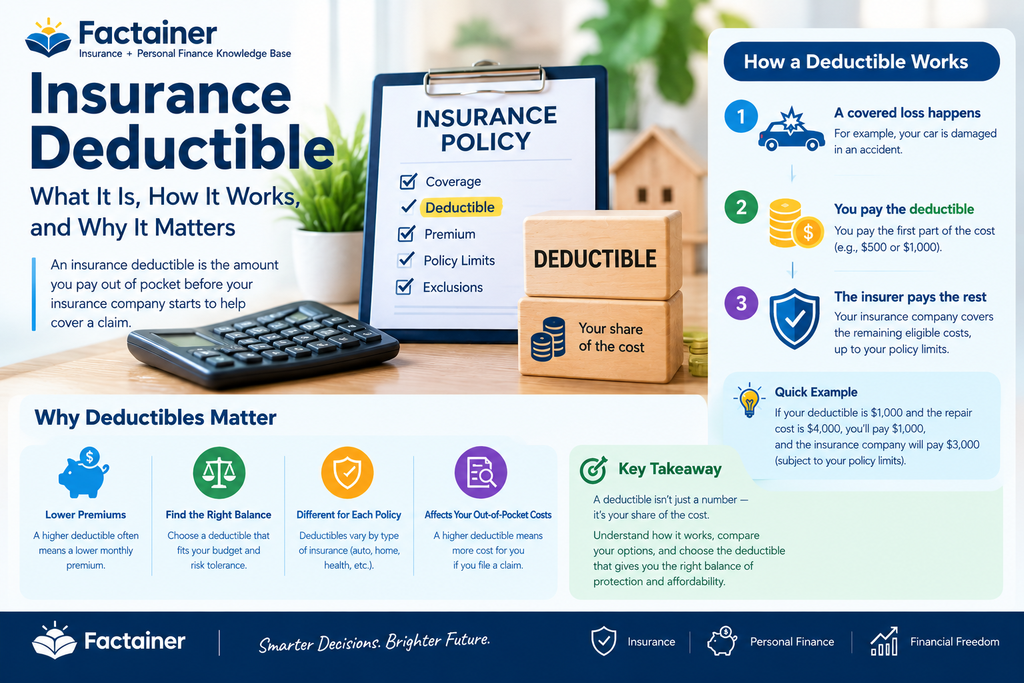
A deductible is an amount you may have to pay yourself before the insurance company pays toward a covered loss.
For example, suppose you have an insurance policy with a $1,000 deductible.
You experience a covered loss that results in $5,000 of eligible expenses.
If the deductible applies, you would generally be responsible for the first $1,000, while the insurer may cover the remaining eligible amount, subject to the policy’s terms and limits.
Deductibles can vary depending on the insurance product.
In some situations, choosing a higher deductible may result in a lower premium.
However, a higher deductible also means you may need more money available if you have to make a claim.
This is why it is important to consider both your premium and your ability to handle the deductible.
What Is Insurance Coverage?
Insurance coverage refers to the protection provided by your policy.
It defines the types of risks, losses, services, or circumstances that the insurer agrees to cover.
For example, an auto insurance policy can contain different types of coverage, while health insurance can have different rules for covered medical services.
Coverage is usually subject to conditions, exclusions, and limits.
When reviewing an insurance policy, ask:
- What exactly is covered?
- What is not covered?
- What is the coverage limit?
- What deductible applies?
- Are there additional out-of-pocket costs?
- What conditions must I meet?
- How do I file a claim?
These questions can help you understand the actual protection provided by the policy.
What Are Insurance Coverage Limits?
A coverage limit is the maximum amount an insurer may pay for a covered loss under a particular part of a policy.
For example, if a policy has a $50,000 coverage limit for a particular type of loss, the insurer generally will not pay more than that limit for that coverage, subject to the policy terms.
Coverage limits are important because a policy can technically provide insurance while still leaving you exposed to significant costs if the limit is too low for a major loss.
When choosing insurance, consider the potential size of the financial loss you are trying to protect against.
What Are Insurance Exclusions?
An exclusion is something that an insurance policy does not cover.
Exclusions are an important part of understanding insurance because people sometimes assume that having insurance means every related loss is covered.
That is not necessarily the case.
Policies can exclude particular events, circumstances, types of property, or other risks.
For this reason, reading the exclusions section can be just as important as reading the coverage section.
If you do not understand an exclusion, ask the insurer or a qualified insurance professional to explain it before relying on the policy for protection.
How Does an Insurance Claim Work?
An insurance claim is the process of asking your insurer to provide benefits for a covered loss.
Although the exact process varies by insurance type and company, it commonly involves several steps.
Report the event
First, notify the insurer about the incident according to the policy’s requirements.
For example, this might involve reporting a car accident, property damage, or another covered event.
Provide information
The insurer may request documents, photographs, receipts, reports, medical information, or other evidence relevant to the claim.
The information required depends on the type of claim.
Claim investigation
The insurance company reviews the claim to determine whether the loss is covered.
The insurer may also determine the amount of the eligible loss and whether any policy conditions or exclusions apply.
Claim decision
After reviewing the claim, the insurer may approve it, partially approve it, deny it, or request additional information.
If approved, payment is made according to the policy terms.
What Are the Main Types of Insurance?
There are many types of insurance, but several are particularly relevant to individuals and families.
Health Insurance
Health insurance is designed to help pay for eligible healthcare expenses.
Depending on the policy, you may encounter premiums, deductibles, copayments, coinsurance, provider networks, and out-of-pocket limits.
Because health insurance can involve many different costs, looking only at the monthly premium does not give you the complete picture.
Auto Insurance
Auto insurance provides different forms of financial protection related to driving and vehicle ownership.
Depending on the policy and jurisdiction, coverage may include liability, collision, comprehensive coverage, medical payments, uninsured or underinsured motorist protection, and other options.
The exact coverage available depends on your policy and local requirements.
Homeowners Insurance
Homeowners insurance can protect against certain covered property losses and liability risks.
A policy may cover the home, personal belongings, additional living expenses, or liability under specified circumstances.
However, homeowners should pay close attention to policy limits and exclusions.
Renters Insurance
Renters insurance is designed for people who rent their homes.
While a landlord generally owns the building, renters still have personal belongings and may have liability risks.
A renters insurance policy can provide certain types of protection for personal property and liability, depending on its terms.
Life Insurance
Life insurance provides a financial benefit to designated beneficiaries after the insured person’s death, subject to the policy terms.
Life insurance can be particularly relevant when other people depend on your income.
The amount of coverage someone needs can depend on income, debts, dependents, savings, future expenses, and existing financial resources.
Disability Insurance
Disability insurance can provide income replacement when a covered disability prevents someone from working.
Because employment income is an important financial resource for many households, disability coverage can play a role in managing income-related risk.
The definition of disability and other requirements vary by policy.
How Much Insurance Do You Need?

There is no single amount of insurance that is appropriate for everyone.
Your insurance needs depend on your financial situation and the risks you are trying to manage.
A useful starting point is to ask:
What financial loss would be difficult for me to handle with my current savings?
For example:
- Could you replace your vehicle after a major loss?
- Could you handle a large medical expense?
- Could your family manage financially if you died unexpectedly?
- Could you pay your mortgage or rent if you could not work?
- Could you rebuild or replace important belongings after a covered loss?
These questions can help you identify where financial protection may be most important.
Insurance should work alongside savings and other parts of your financial plan.
How to Choose the Right Insurance Policy
Choosing an insurance policy is not simply about finding the lowest price.
Start by identifying the risk you want to protect against.
Then compare policies based on several factors.
Compare coverage
Look at what each policy actually covers rather than comparing premiums alone.
Check deductibles
Make sure you understand how much you may have to pay yourself before coverage applies.
Review coverage limits
A policy with insufficient limits may leave you responsible for a large portion of a serious loss.
Read exclusions
Understand which risks are specifically excluded from the policy.
Consider your budget
Your insurance should fit within your broader financial plan.
Review your coverage regularly
Your needs can change when you buy a home, get married, have children, change jobs, buy a new vehicle, or experience a major change in your finances.
Common Insurance Mistakes to Avoid
Understanding how insurance works can help you avoid several common mistakes.
Choosing insurance only because it is cheap
A low premium does not automatically mean adequate protection.
Ignoring the deductible
A policy can look affordable until you discover how much you would need to pay after a claim.
Not reading exclusions
Knowing what your policy does not cover is essential.
Buying too little coverage
Insufficient coverage can leave you exposed to significant financial losses.
Never reviewing your policy
Your insurance needs may change over time.
Insurance and Your Personal Finance Plan
Insurance is only one part of personal financial planning.
Your overall financial strategy may also include budgeting, emergency savings, debt management, investing, and retirement planning.
Insurance and savings serve different purposes.
For example, an emergency fund can help you handle smaller unexpected expenses, while insurance can help protect against certain larger risks covered by a policy.
This is why it can be useful to think about insurance as part of a broader financial risk-management strategy.
The goal is not necessarily to insure every possible problem.
Instead, the goal is to understand which financial risks could have the biggest impact on you and determine how you want to manage them.
Frequently Asked Questions
How does insurance work in simple terms?
You pay an insurance company a premium in exchange for protection against specific risks covered by your policy. If a covered event happens, you can file a claim, and the insurer may pay eligible costs according to the policy terms.
What is the difference between a premium and a deductible?
A premium is the amount you pay to maintain your insurance coverage. A deductible is an amount you may have to pay yourself toward a covered loss before the insurer pays according to the policy.
Does insurance cover everything?
No. Insurance policies have exclusions, coverage limits, conditions, and other restrictions. What is covered depends on the specific policy.
Why do insurance companies charge premiums?
Premiums help insurance companies collect money to provide coverage and pay eligible claims and other expenses associated with operating the insurance business.
Is cheaper insurance always better?
No. A cheaper policy may provide less coverage, have higher deductibles, or have lower limits. Comparing the complete policy is more useful than comparing premiums alone.
How often should I review my insurance?
Consider reviewing your coverage after major life or financial changes and periodically to make sure it still matches your needs.
Final Thoughts
So, how does insurance work?
The basic idea is straightforward: you pay a premium to an insurance company in exchange for financial protection against specific risks covered by your policy.
When a covered event occurs, you can file a claim. The insurer reviews the claim and, if it qualifies under the policy, pays the eligible amount subject to deductibles, coverage limits, exclusions, and other terms.
The most important part of buying insurance is understanding what you are actually paying for.
Do not look only at the premium. Consider the coverage, deductible, limits, exclusions, claim process, and your own financial situation.
Once you understand these basics, insurance becomes much easier to evaluate as part of your overall personal finance strategy.